
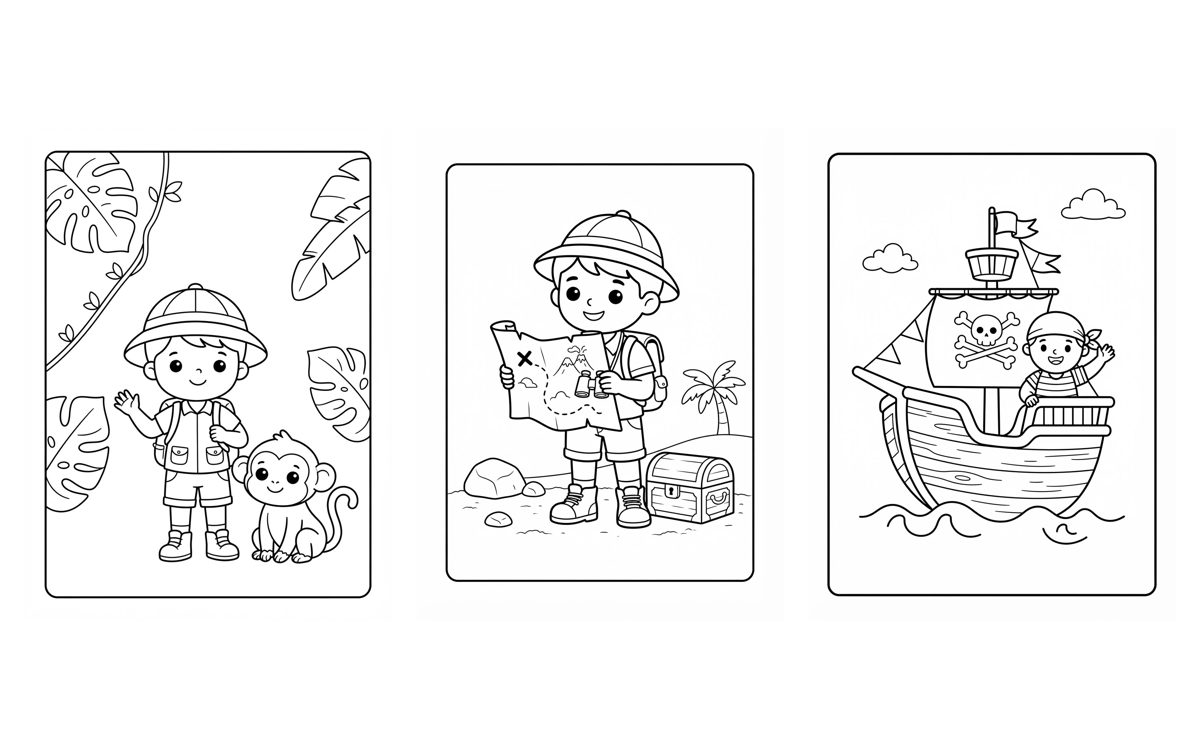
Some of the best adventures happen without leaving the house. With a few household items, some printable pages and a bit of imagination, a rainy afternoon or a long weekend can turn into an expedition. Here are eight easy ideas for an explorer day at home that work for a single child, siblings or a small group.
1. Build your explorer kit
Every explorer needs gear. Make binoculars by taping two empty toilet paper tubes together, fold a paper hat or use a cap, and pack a small backpack with a notebook, a pencil and a water bottle. Letting kids prepare their own kit gets them excited and gives them a sense of ownership of the adventure.
2. Start with an explorer coloring page
Begin the day with a calm warm-up. Our Little Explorers coloring pages show young adventurers in the jungle, the desert, on a pirate ship and in the arctic. Kids can choose the scene that matches today's mission, color it in and talk about where their explorer is going.
3. Draw a treasure map
Ask your child to draw a simple map of a room or the garden, with landmarks like the sofa mountain, the kitchen river or the garden forest. Add an X for the treasure, a dotted path to follow and a compass in the corner. Drawing a map practices planning, spatial thinking and pencil control all at once. Younger children can describe the map while a grown-up draws.
4. Go on a treasure hunt
Hide a small prize, such as a few stickers, a snack or a favorite toy, and let the map lead the way. For children who are not reading yet, use picture clues instead of words: a drawing of the fridge, a sketch of the bookshelf. For older kids, write short riddles that lead from one hiding place to the next.
5. Play safari animal spotting
Print a handful of animal pages, such as our Cute Animals coloring pages, and hide them around the room at a child's eye level. Give your explorer a checklist and the paper binoculars, and let them spot, name and tick off each animal. When the safari is over, they can color the animals they found.
6. Set sail on a pirate ship
An upside-down laundry basket, a large cardboard box or a few couch cushions can become a ship. Add a paper flag, a telescope made from a rolled-up sheet of paper and a pirate page to color as the ship's official flag or logbook. Playing pirates is a lively way to burn off energy indoors.
7. Make a blanket-fort campsite
Drape a blanket over chairs for a tent, gather soft pillows and use a battery-powered flashlight as the campfire. Snuggle inside with a snack and read an adventure story or color a camping scene together. It is a cozy, quiet way to wind down after a busy day of exploring.
8. Keep an explorer journal
End the day by collecting the finished pages into a little journal: staple together the colored explorer page, the treasure map and a few blank sheets. Kids can draw the most exciting thing they discovered and write or dictate a sentence about it. For extra drawing practice, add a Complete the Drawing page or a Trace & Color page as a "mystery find" to finish.
Safety first: stay close to young explorers, especially during any outdoor part of the adventure, and keep small items such as stickers, beads and tape out of reach of children under three. Choose hiding places that are easy and safe to reach.
Tips for a smooth adventure day
- Keep it short. Young children are happiest with a few small missions rather than one long one.
- Adapt to the age. Offer picture clues and big shapes for ages 3 to 4, short riddles for ages 5 to 7, and a more detailed map and journal for ages 8 and up.
- Use what you already have. Cardboard, tape, blankets and a flashlight are plenty.
- Let kids lead. Ask where the explorer wants to go next and follow their ideas.
- Celebrate the finish. Hang the finished pages on a wall as an "expedition gallery".
Try it with these printable pages
- Little Explorers coloring pages: jungle, pirates, safari and treasure maps
- Cute Animals coloring pages for your safari spotting game
- Complete the Drawing activity pages: half-drawn sheets to complete
- All coloring pages to browse every theme