
Scene 1
The Missing Sound
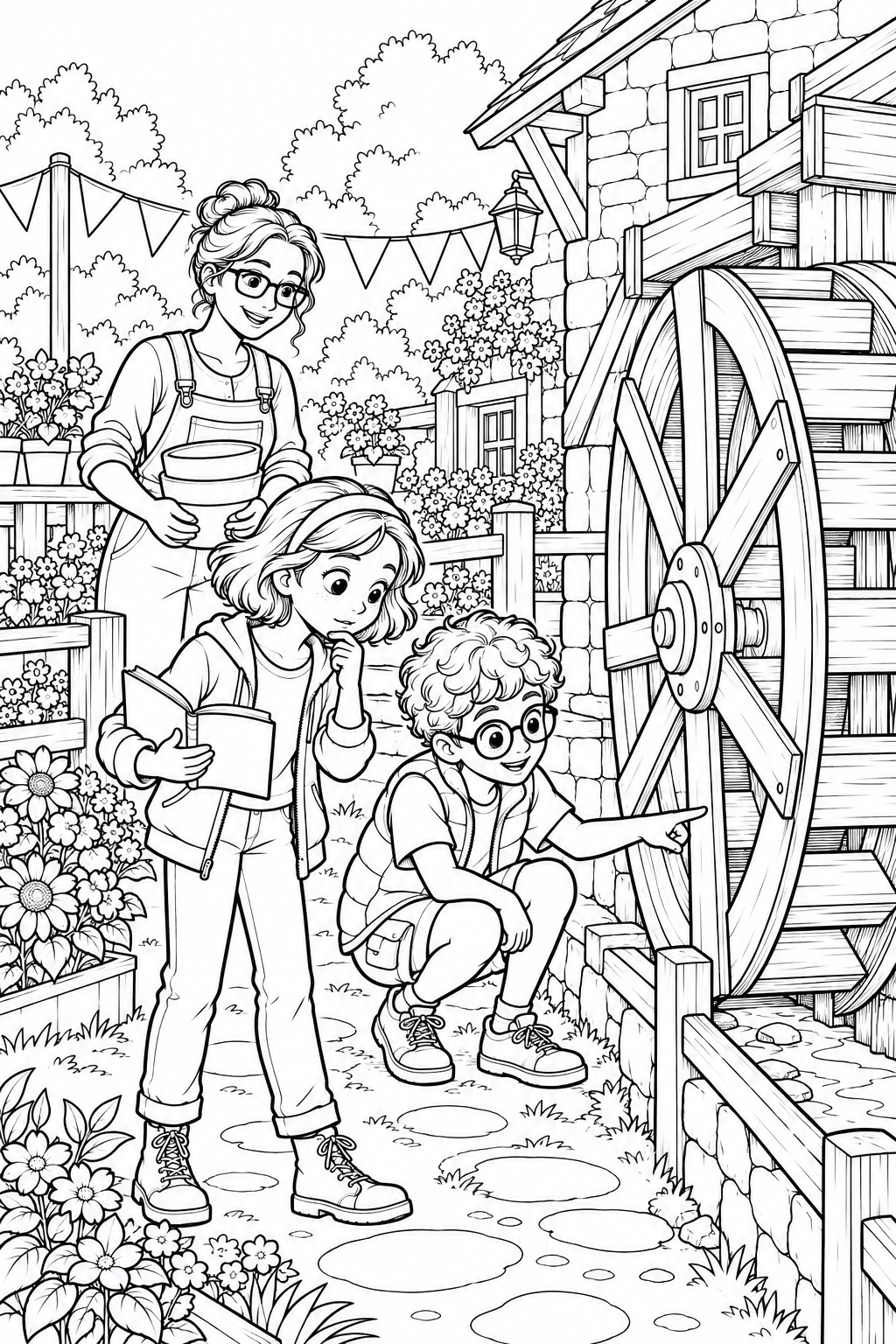
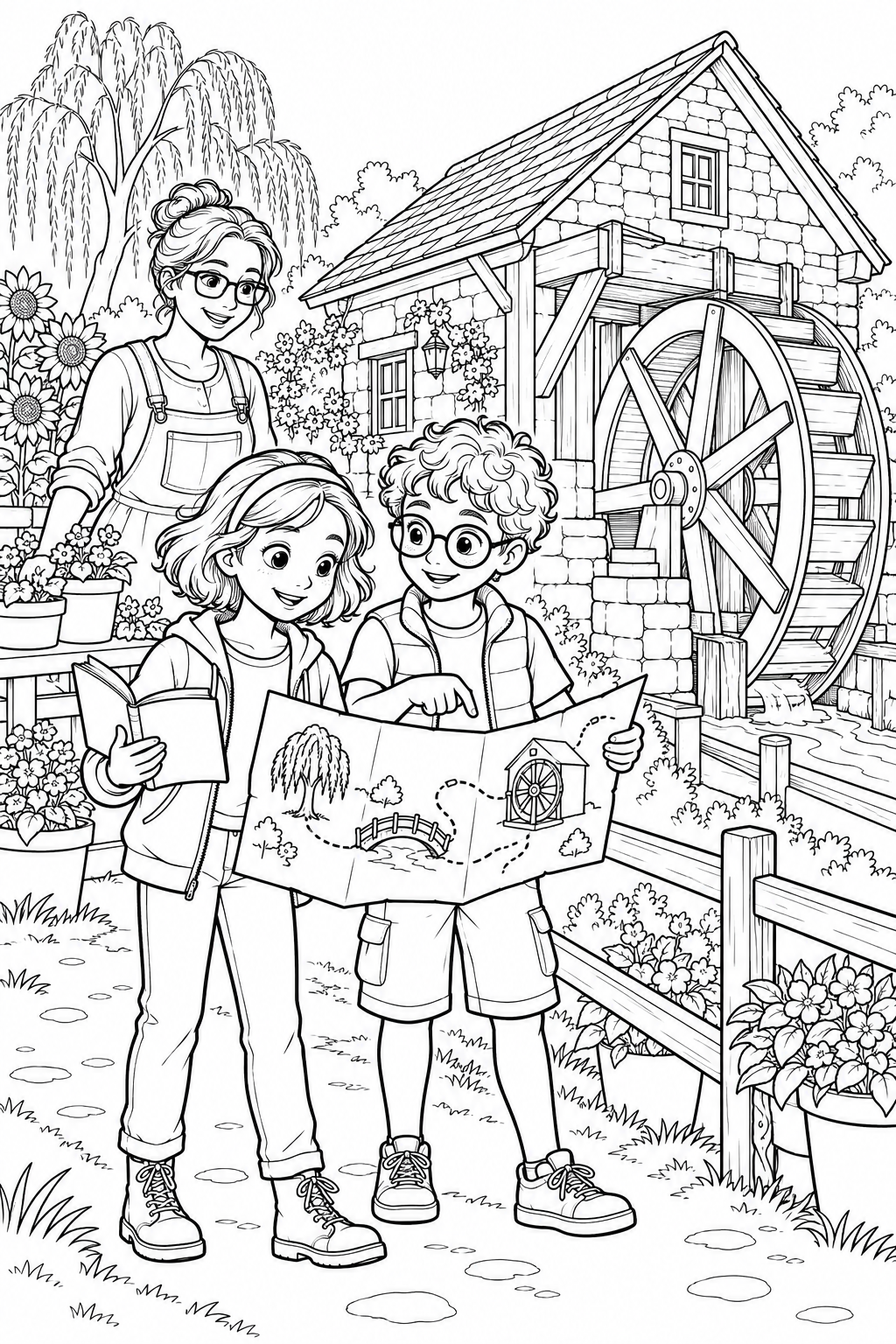
On Saturday morning, Nora heard something strange at the community garden: nothing. Usually, the old mill’s waterwheel greeted visitors with a cheerful clack-clack-clack. Today, it stood still.
Tomorrow was the garden festival. Mara, the caretaker, was arranging pots by the mill. The wheel powered a small pump that filled the garden’s watering tank, and she had planned to show everyone how it worked.
“We can water the plants with cans today,” Mara said. “But I’d like to discover what has stopped our wheel.” Nine-year-old Nora immediately opened her notebook. A real mystery!
Leo, her friend, crouched on the dry path outside the railing. “The channel under it looks nearly empty,” he said. Nora barely heard him. She was examining the wheel’s wooden paddles.
“One of the gears must be broken,” she announced. “That is what happens to old machines.” She wrote BROKEN GEAR in large letters, pleased with her quick explanation.
Mara set down the pots. “That is an idea. What have you actually observed?” Nora looked again. No snapped wood, no loose pieces. Just a wheel that wasn’t turning.
Slowly, she crossed out her heading and wrote two smaller ones: WHAT WE KNOW and WHAT WE THINK. Under the first, she put: wheel still; little water in channel.
From a drawer inside the mill, Mara brought an old garden map. A willow, a bridge and the mill were sketched on it. “Shall we investigate together?” she asked. This time, Nora nodded before making another guess.
Scene 2
A Small Wheel, a Big Question
Before following the map, Mara checked the big wheel. She briefly disconnected the pump and carefully turned the wheel by hand. It moved smoothly. Then she connected the pump again.
“A jammed wheel seems less likely now,” said Leo. Nora added the test to her notebook. Her first explanation was already looking less convincing.
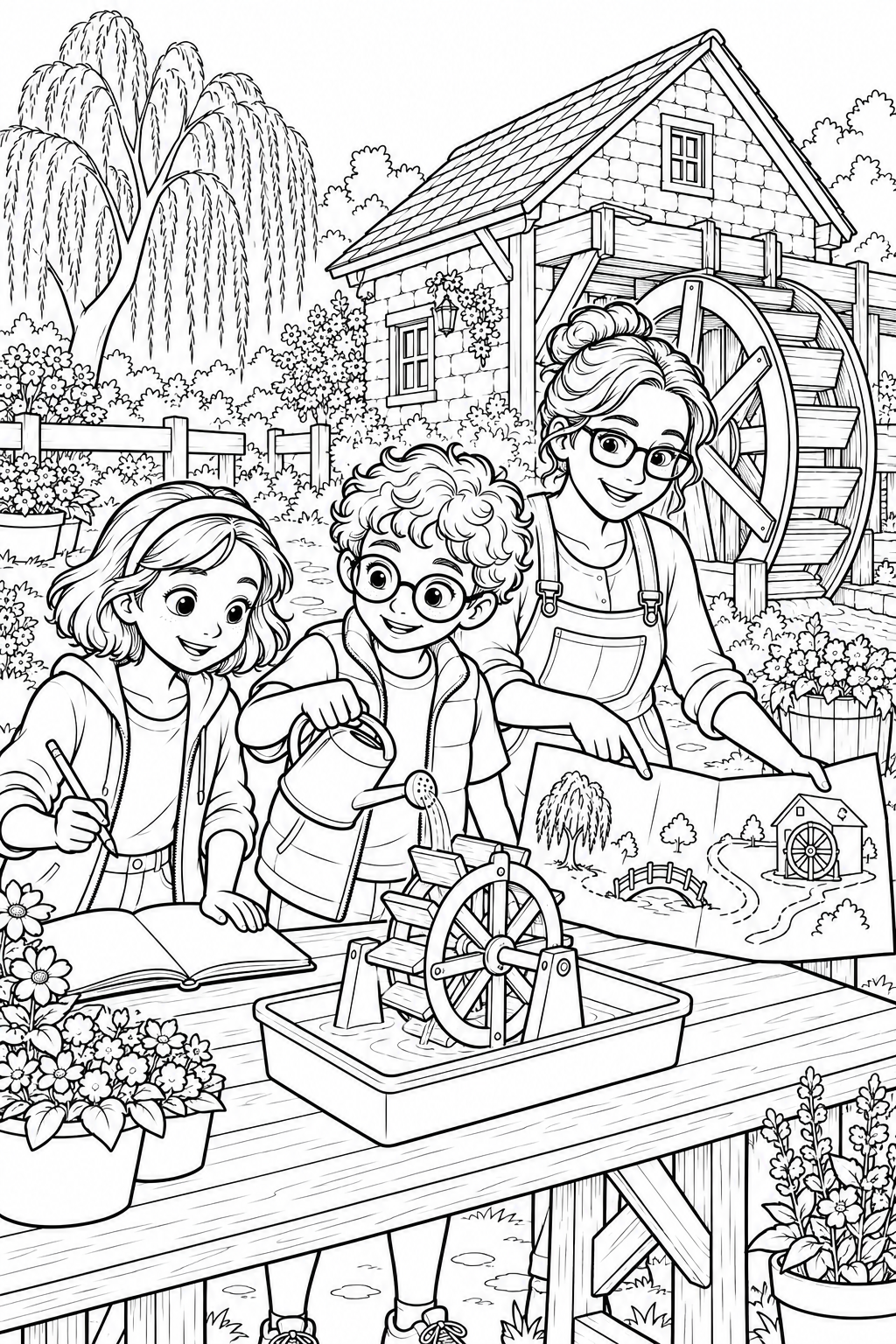
On the worktable stood a miniature waterwheel that Mara used for demonstrations. Leo placed a basin beneath it and picked up a little watering can. “Let’s see what the water does.”
He poured a thin trickle onto a paddle. The model twitched, then stopped. With a steadier stream, it began to turn. Nora watched the paddles take turns catching the water.
“So water pushes it,” she said. “And a tiny trickle might not be enough.” She drew the model and an arrow showing the direction of its movement.
“Does that prove the big wheel needs more water?” Leo asked. Nora almost answered yes. Then she paused. They had tested a model, not the wheel beside the mill.
“It gives us a reason to check the water supply,” she said. Mara smiled. “Exactly. A useful experiment can tell us what question to ask next.”
They unfolded the map across the table. A winding channel led from the stream near the willow to the mill. If the stream still had water, where was the garden’s share going?
Scene 3
The Map’s Two Lines
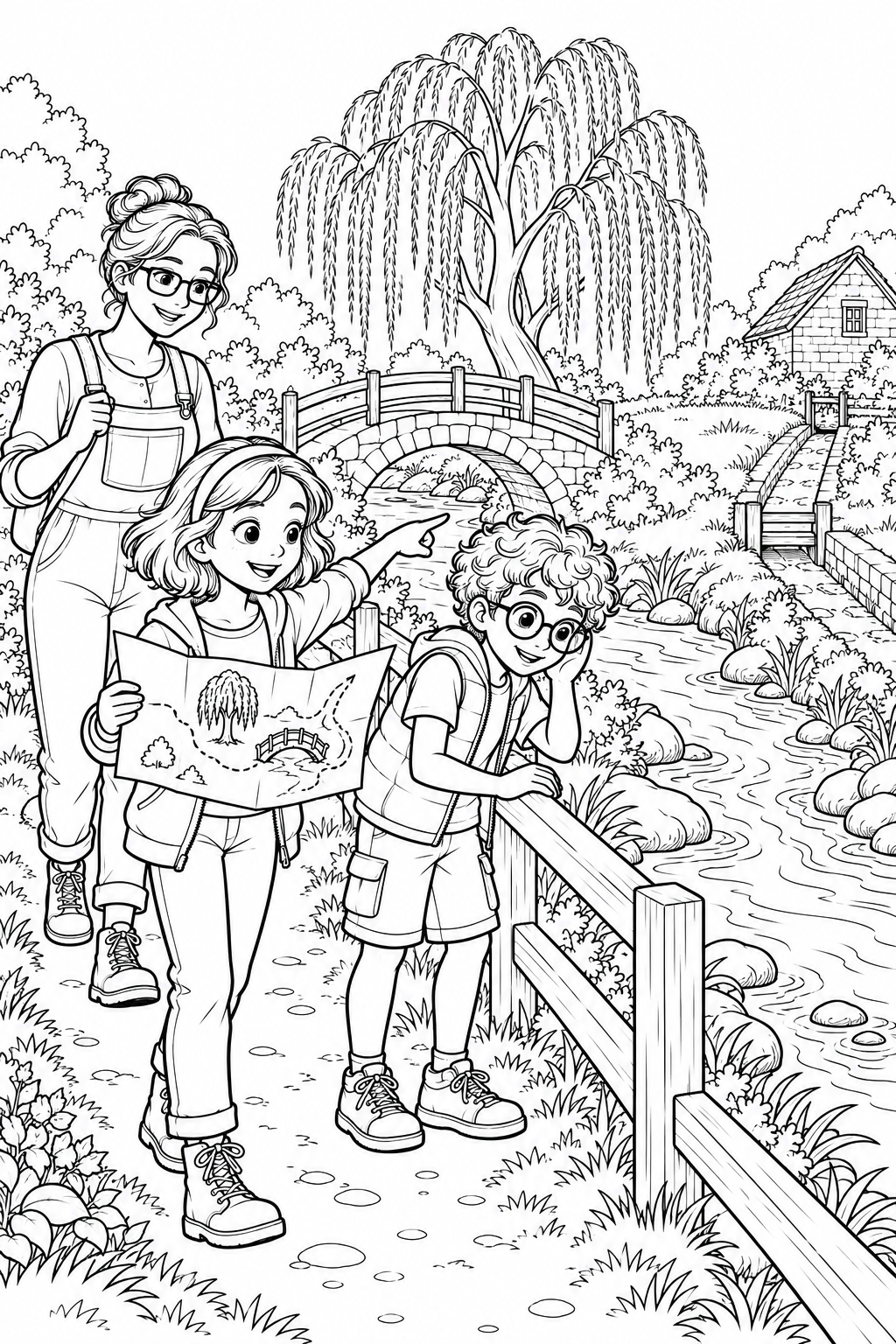
Mara led them along the dry garden path to the little bridge. Below the railing, the main stream bubbled around stones. Leo stopped to listen. There was certainly plenty of water here.
“Then the wheel should be turning!” Nora exclaimed. But Leo pointed to a narrow side channel. A few wet patches shone on its bottom, with no steady flow toward the mill.
They had found something important: water in the main stream did not mean water was reaching the wheel. Nora drew a fork in her notebook and marked which branch was nearly dry.
On the old map, two lines curled around the willow. One was dotted, the other solid. Nora followed the dotted one with her finger. “The water must go this way.”
“Are you sure?” asked Leo. He compared the map with the bend in the path. “We’re standing on that dotted line. Perhaps it is the walking route.”
Nora checked the little symbol beside the bridge. He was right. She had been following the path instead of the channel. “Good catch,” she said, turning the map to match the garden.
A tiny square crossed the solid line near the willow. Nora had mistaken it for a stepping stone. Mara explained that it marked a wooden gate which controlled water entering the garden channel.
The three of them continued along the fenced path. Near the willow, the stream still made its busy sound. The small gate, however, was almost shut.
Scene 4
A Clue with Leaves
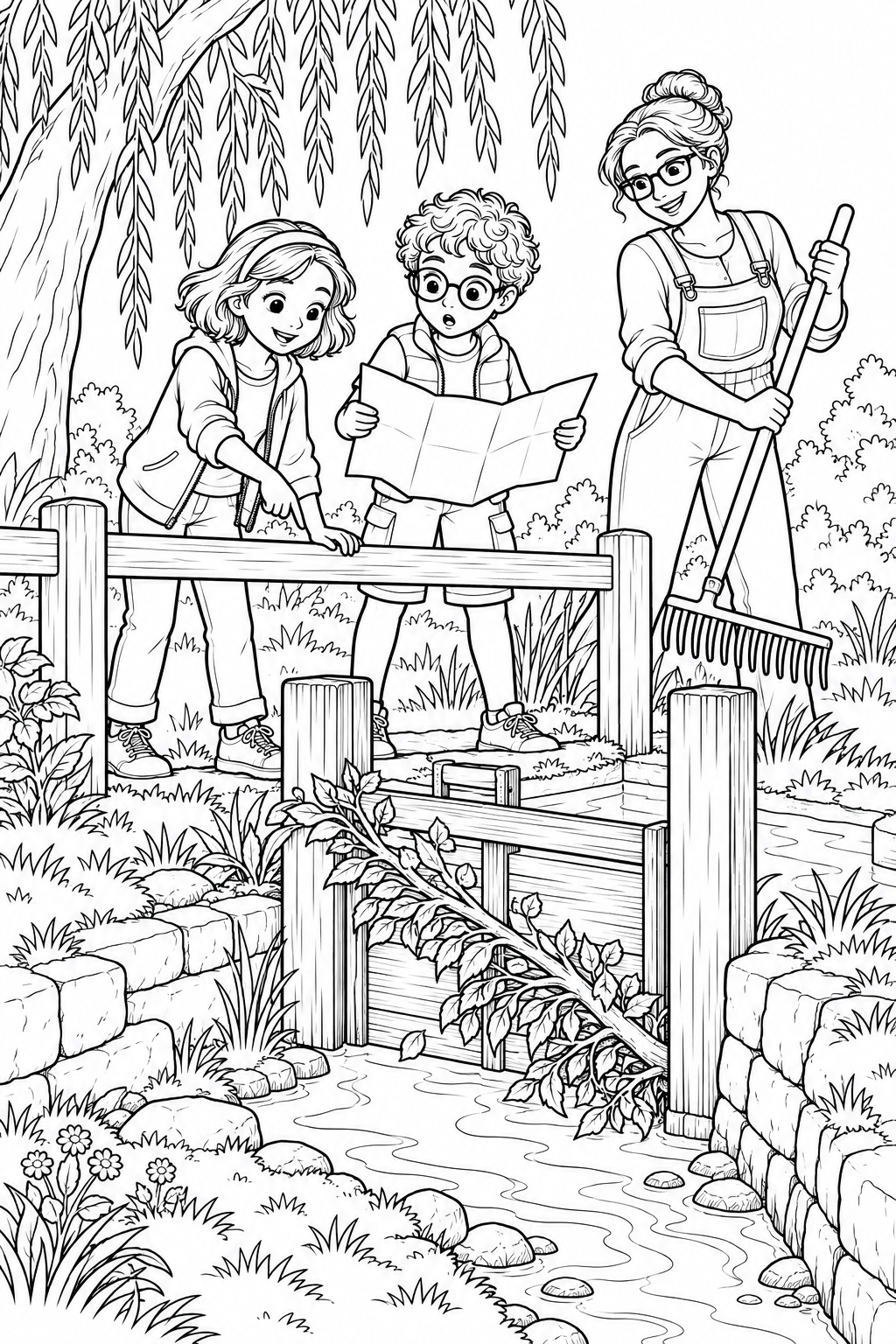
A leafy branch lay diagonally across the gate’s wooden guides. Water gathered on one side of the panel; on the other, only a thin thread escaped into the garden channel.
Nora leaned forward from the path. “There! A broken piece of the waterwheel.” Leo studied it without touching. “But wooden paddles don’t grow leaves.”
For a moment, Nora felt her cheeks warm. She had been so eager to be right that she had squeezed a new clue into her old explanation. Then she laughed. “That would be a very unusual wheel.”
Mara pointed to a fresh break high in the willow. “We had strong wind last night. That branch seems to have fallen into the gate and caught in its guides.”
“So the wheel may be fine,” Nora said. “The gate is blocking most of its water.” This explanation matched the low channel, the flowing stream and the leafy branch.
Still, they had not tested it. In her notebook, Nora drew the branch, the gate and the two water levels. Beneath them she wrote: clear gate, restore flow, watch wheel.
“We’ll leave the lifting to me,” Mara said, fetching the garden rake and checking the gate’s handle. Nora and Leo stayed behind the railing, where they could see without getting in her way.
Nora handed Leo the notebook. “Would you check whether I’ve missed anything?” she asked. A few minutes earlier she had wanted to solve the mystery by herself. Now she wanted their explanation to hold up.
Scene 5
The Test That Mattered
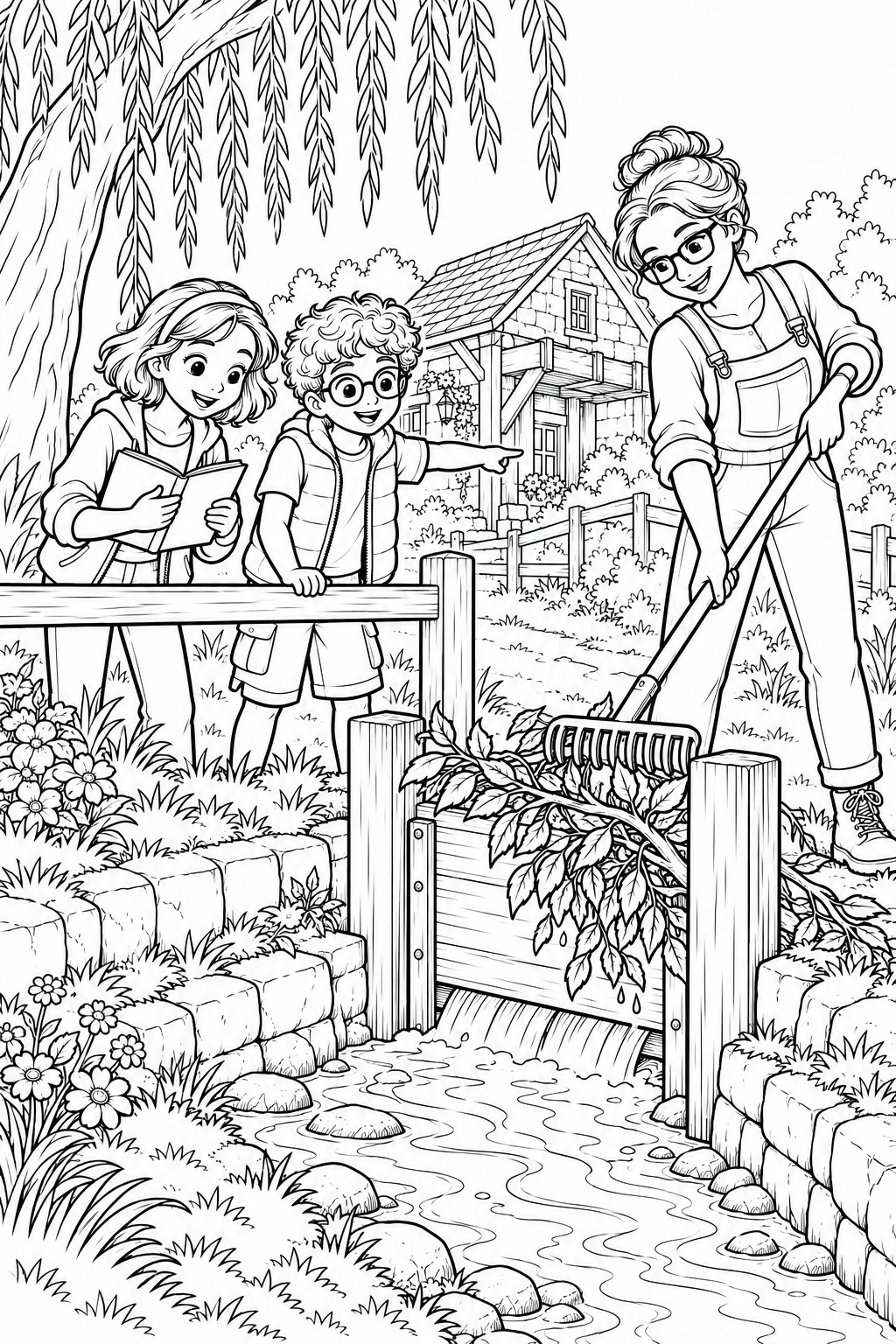
Working from the dry service path, Mara used the long rake to lift away the trapped branch. She laid it beside the willow, then eased the wooden gate upward with its handle.
Water slid into the narrow channel. Leo grinned, but Nora kept her pencil ready. Their prediction was clear: if the wheel was stopping because too little water reached it, the restored flow should make it turn.
They walked back toward the mill together. For a few breaths, the wheel was still silent. Nora’s stomach fluttered. Had they missed another problem?
Then the front of the flowing water reached the paddles. One dipped, the rim moved a little, and the next paddle caught the current. Clack. Clack-clack. The sound grew steady.
From the pump’s outlet came a small stream into the watering tank. Mara checked the connection and the flow. “Our demonstration is back,” she said. “And the plants will have their water.”
Leo gave a delighted little bow to the wheel. Nora wrote the result below their prediction. They had not merely found an interesting clue: they had checked what happened when they changed its cause.
“I was wrong about the broken gear,” she said. “And about that leafy paddle.” Leo smiled. “You were right to keep looking.”
They carried the fallen branch to the garden’s wildlife pile with Mara. Tomorrow, the visitors would hear more than the waterwheel’s cheerful rhythm. They would hear the story of how it had returned.
Scene 6
A Better Map
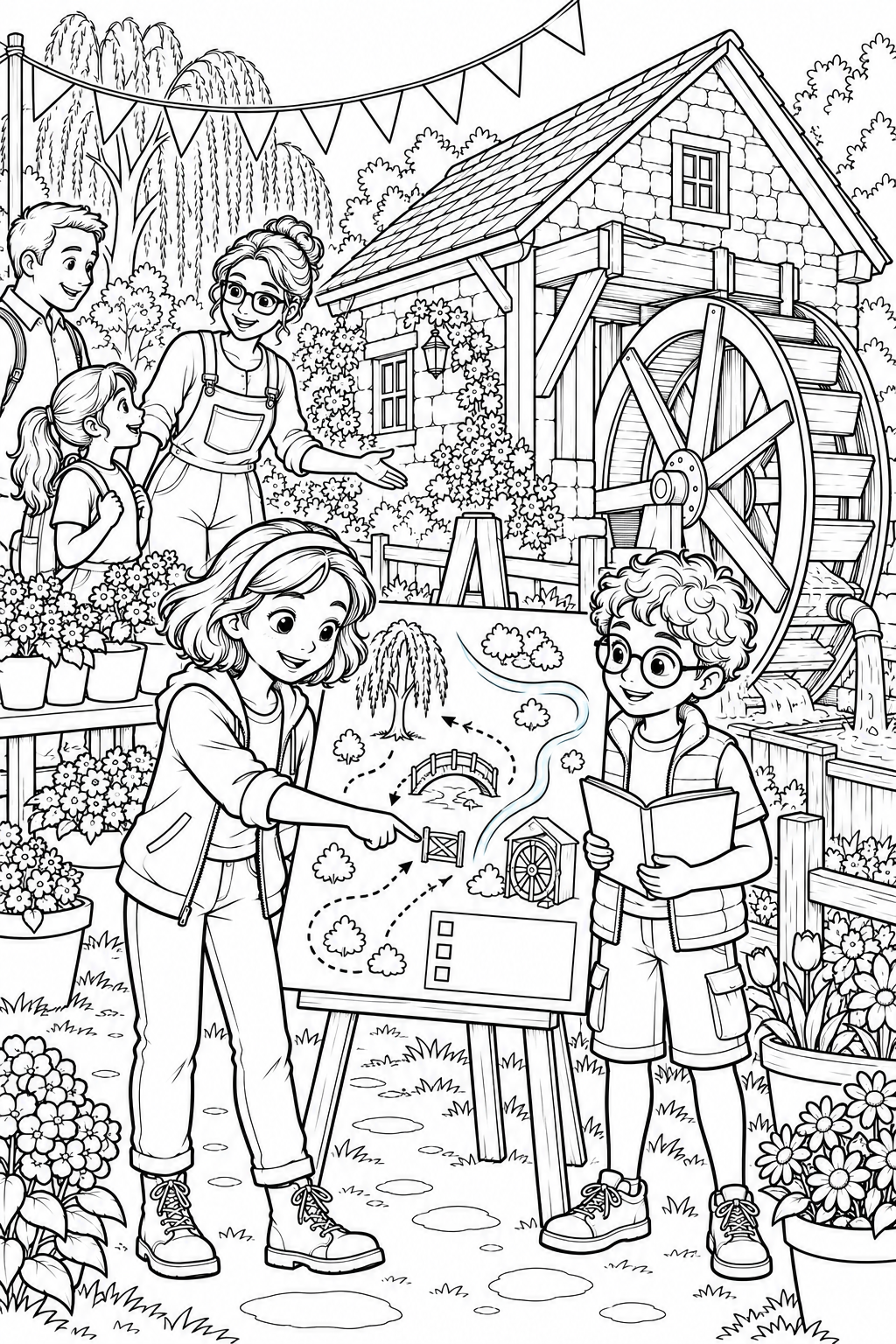
On Sunday, bright bunting stretched between the garden posts. Visitors listened to the waterwheel and watched the pump fill the tank. Beside the mill stood a new map drawn by Nora and Leo.
They had made the channel a clear solid line and the walking path a dotted one. A small key explained the symbols. The gate was easy to find, and an arrow showed how water traveled toward the wheel.
Mara added a reminder to check for fallen branches after windy weather. The mystery had given them something useful: a way to care for the garden before the same trouble returned.
A younger visitor pointed to Nora’s notebook. “Did you know the answer straight away?” Nora considered telling only the part about discovering the branch. That would have sounded impressively clever.
Instead, she showed him the crossed-out guess, the little experiment and Leo’s correction to the map. “No,” she said. “We found the answer by checking ideas, including the ones that didn’t work.”
“And by looking at the same place in different ways,” Leo added. He had noticed the water, Nora had kept track of the clues, and Mara knew how the garden’s machinery worked.
Nora turned to a fresh notebook page and wrote a new heading: QUESTIONS WORTH ASKING. Under it she put: What do we notice? How could we check? What might we have missed?
The wheel clacked behind her. Nora no longer thought a good detective was someone who always had the first answer. A good detective knew when to ask the next question—and when to listen to a friend.