
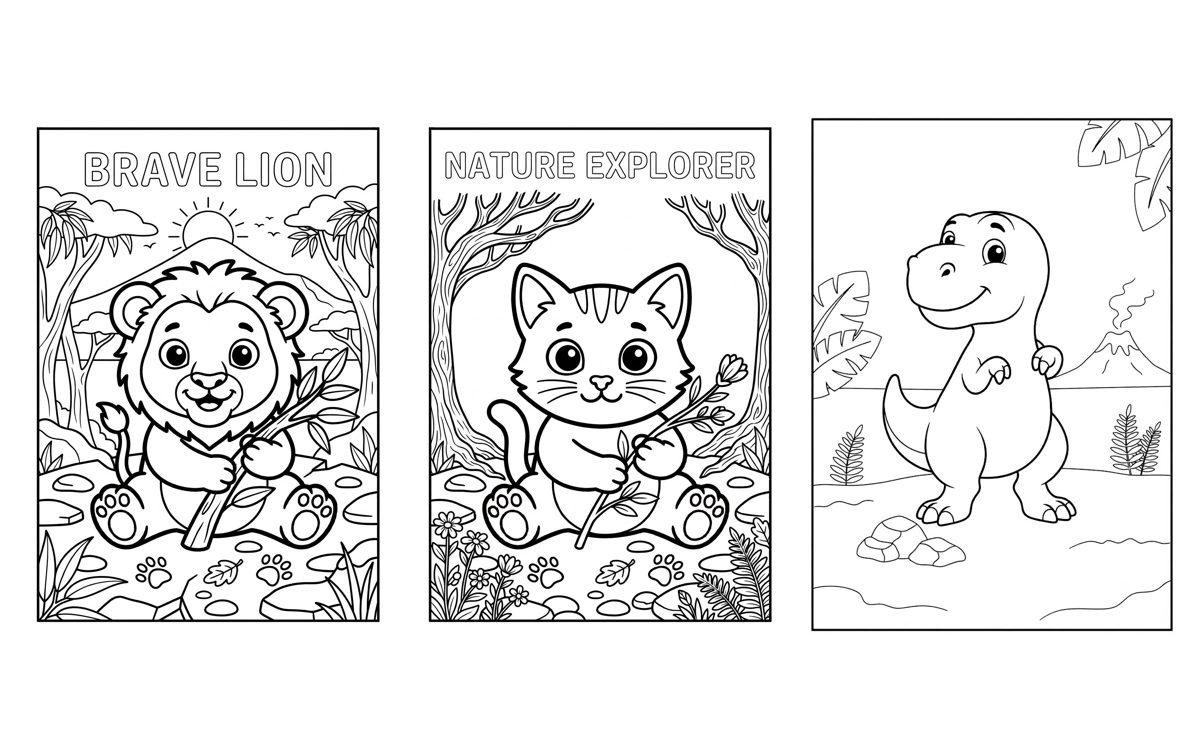
A printable can be a place to try a pencil movement, choose colors or tell a story together. What a child practices depends on how the page is used; finishing a picture does not measure readiness for school. Here are eight ways to make coloring useful without turning it into a test.
Start with one page the child wants to try, paper and a few crayons or colored pencils. Use “Fit to page” in the print preview to keep the border visible. The ideas below are alternatives: choose one, and leave the rest for another day.
1. Find a comfortable movement
Open Cute Animals and choose one large area, such as the lion’s mane. Try short strokes, then wider sweeps. Ask which feels comfortable. Smaller details can wait; the whole page does not need to be filled.
2. Give attention a small destination
Agree on a stopping point such as “one ear” or “three patches,” rather than completing the picture. At that point, ask whether the child wants to continue. This offers practice returning to a chosen task without making a long session the goal.
3. Follow a visible boundary
On Blast-Off Rocket, trace one dotted part of the outline before coloring nearby. Point out the solid porthole and the dotted body so the child can decide where the pencil goes. There is no need to erase every mark outside a line.
4. Compare two color choices
Offer two or three colors and let the child choose where each goes. Try a patch on scrap paper first. Ask “Which looks lighter?” or “Would you use that color again?” A purple lion is as welcome as a brown one.
5. Add something the page does not show
Invite the child to invent weather, a name or a place for the animal. For a page designed around adding marks, try Lion Mane Studio: its zigzags, loops and outward strokes can become three different manes.
6. Make room for quiet or conversation
Some children enjoy talking as they color; others prefer silence or another activity entirely. Offer a quiet seat and ask whether they want company. Coloring can be part of a restful routine, but it does not have to calm every child.
7. Notice straight and curved strokes
Compare a straight mark with a curved one on spare paper. If the child wants a path to follow, use one line from Rainy Day Raindrops. These are opportunities to practice marks used in drawing and writing, not a handwriting assessment.
8. Let the child describe the result
Ask “Which part would you like to show me?” rather than judging neatness. Write down the child’s own title if requested. An unfinished picture can still contain a choice, a new stroke or a story worth sharing; ask before displaying it.
If the page feels too difficult
- Choose a larger area or cover unused rows with scrap paper.
- Offer a tool the child can hold comfortably, and keep the sheet from sliding.
- If the hand tires or the child loses interest, stop or switch to free drawing.
Choose by interest and comfort: age labels are suggestions. Coloring is one option alongside building, movement and imaginative play. Persistent pain or difficulty using drawing tools is something to discuss with a teacher or health professional, not to solve by adding more worksheets.
Try it with these printable pages
- Cute Animals for choosing a familiar subject.
- Blast-Off Rocket for tracing a visible outline.
- The pencil-control guide for choosing between lines, waves and drawing prompts.