
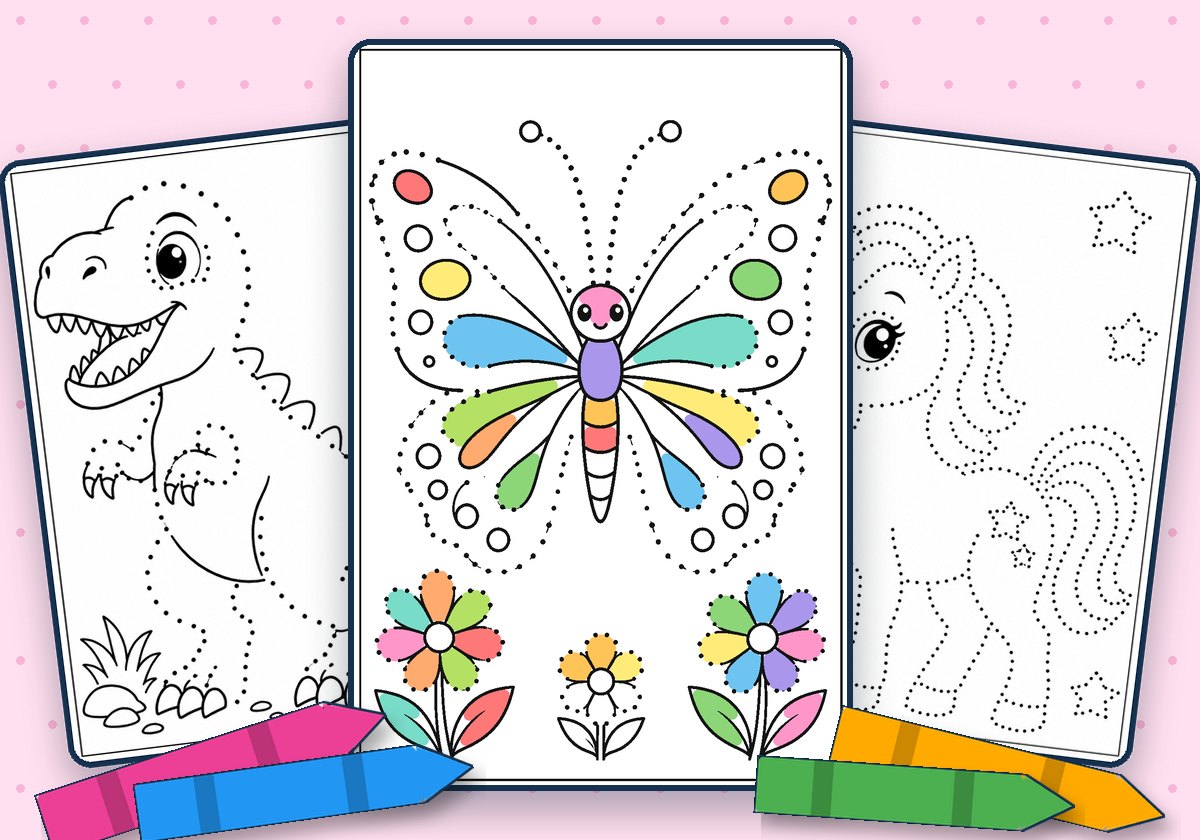
A rocket takes shape one short line at a time; a butterfly gains an outline before its wings fill with color. Trace & Color combines following a dotted outline with choosing how to color the picture. The collection includes ten printable subjects, from a dolphin to a detailed castle, each with its own guide.
The dots are not numbered. Children follow the dotted parts of the drawing; the solid lines already show details such as eyes, windows or decorations. There is no hidden picture to solve, and no need to trace every part in one sitting.
Choose a picture by its lines
Start with a subject the child likes, then look at the size and number of turns. The ages in the guides are suggestions: a child can try one section of a detailed page or enjoy a simpler picture again.
- Blast-Off Rocket has one large body, two fins and a flame. Its guide suggests ages 4–6; the mixture of broad curves and clear corners gives you distinct places to pause.
- Happy Dolphin, also suggested for ages 4–6, offers a long curved body and waves. Choose it for flowing paths rather than lots of small corners.
- Butterfly Garden has wing edges, round spots and antennae to trace. Try one wing first, then notice similar shapes on the other. Matching colors are an option, not a rule.
- Little Lion has many small turns around its mane. Its suggested range is 5–8; choose just a few curves if the full mane feels like too much.
- Fairytale Castle, suggested for ages 6–8, has several towers and connected edges. It can be a project spread over more than one session.
Prepare the page and materials
Open a worksheet’s guide and use Print, or Save to download its image. Check the print preview on A4 or Letter paper and choose “Fit to page” so the border remains visible. The worksheets print in black and white; the partly colored collection preview is an example of how they might look afterward.
Set out a pencil or dark crayon for tracing and a few coloring pencils or crayons. Put the sheet on a stable surface. If using markers, test them on spare paper and protect the table from ink passing through.
Try the rocket together, one section at a time
- Look before drawing. Find the dotted body and the solid round window. Ask the child to point to one line they will trace.
- Follow with a finger. Start at the nose and follow a short part of the body. Decide where to stop before picking up the pencil.
- Trace in pieces. Follow that section, then lift the pencil. Move to a fin or the flame when ready; pausing at a corner is fine.
- Add color. Choose colors for the body, fins, flame or stars. A partly traced picture can still be colored.
- Give the picture a destination. Ask, “Where is this rocket going?” Write down the child’s answer if they want a caption.
What children can practice
The page offers a visible path for coordinating looking and drawing. Children can notice where a curve changes direction, decide when to lift the pencil and distinguish dotted lines from solid ones. Coloring adds choices about areas and colors. These are opportunities to explore movements; a neat outline does not measure writing readiness or guarantee a particular learning result.
Make the task smaller or more open
If the picture feels busy, cover the unused part with spare paper or choose only the dolphin’s back or one butterfly wing. An adult can demonstrate a short curve on another sheet. Let the child pause, change tools or stop when the hand tires.
For a child who wants more freedom, invite a new background, a different color pattern or a name for the character. In class, pairs can each describe where they started and where they paused; they do not need to finish the same amount or work at the same speed.
Questions before you print
Should all the dots disappear?
No. The printed dots may remain visible beside the new line. The task is to explore the route, not to cover every dot perfectly or erase every deviation.
Can a child just color the picture?
Yes. Offer tracing as an invitation. A child may trace one part, color another or return to the outlines later.
What if tracing an outline is still frustrating?
Try a single line from Rainy Day Raindrops or a wide path on spare paper. Come back to the picture when the child wants to; there is no sequence of worksheets they must complete.
For a shorter first try, follow the three illustrated steps in the race-car guide: trace one cloud, add the second and choose a color. The car can wait for another session.
Try it with these printable pages
- Browse all Trace & Color sheets and choose a subject together.
- Open the rocket guide for its printable image and instructions.
- Explore other pencil-control activities if you want to compare straight paths, zigzags and drawing prompts.